


Trusted Financial Planner in Mulgrave for Every Stage
Finding a Trusted Financial Planner in Mulgrave can help you make more informed decisions as your financial priorities change throughout life. Whether you are starting your career, buying a home, building wealth, preparing for retirement or managing your finances after retirement, financial planning can provide structure and direction.
A good financial plan is not designed for just one stage of life. Your income, expenses, family circumstances, investments, superannuation and goals can all change over time. That is why effective financial planning should be flexible and regularly reviewed.
For individuals and families in Mulgrave, personalised financial planning can cover areas such as investment advice, retirement planning, superannuation, insurance, wealth management, cash flow and debt management.

Financial planning is not about planning for one moment in your life. It is about creating a strategy that can evolve with you
What Does a Financial Planner in Mulgrave Do?
A financial planner helps clients assess their financial position, establish goals and consider strategies that may support those goals.
A Trusted Financial Planner in Mulgrave may assist with areas including:
Financial goal setting
Investment planning
Wealth management
Superannuation advice
Retirement planning
Insurance planning
Cash-flow management
Debt management
Financial risk management
Estate planning coordination
The exact services available depend on the adviser’s qualifications, authorisations and scope of advice.
The key difference between a generic financial strategy and personalised financial planning is context. Your recommendations should take into account your individual circumstances rather than assuming that one approach works for everyone.

Why Financial Planning Matters at Every Stage of Life
Your financial priorities are unlikely to remain the same throughout your life.
A young professional may be focused on establishing savings and superannuation. A family may be balancing a mortgage, education expenses and investments. Someone approaching retirement may instead be focused on converting accumulated wealth into a sustainable retirement strategy.
This creates several distinct financial planning stages.
Stage 1: Starting Your Career
Early in your career, retirement can seem far away.
However, this stage can be useful for establishing strong financial foundations.
Key priorities may include:
Building an emergency savings buffer
Managing personal debt
Establishing a regular savings habit
Understanding superannuation
Reviewing insurance needs
Setting short- and long-term goals
Learning about investing
You do not necessarily need a complex investment portfolio at this stage. Understanding your financial position and developing good habits can be valuable foundations.

Stage 2: Buying a Home and Building a Family
As responsibilities increase, financial decisions can become more complex.
You may be managing:
A mortgage
Household expenses
Children
Education costs
Superannuation
Investments
Insurance
Career changes
At this stage, financial planning often becomes more about balancing competing priorities.
Important Areas to Review
Cash Flow
Understanding where household income goes can help identify savings and investment opportunities.
Debt
Mortgage and other debts can have a significant impact on household cash flow.
Insurance
If other people depend on your income, financial protection can become an important consideration.
Investments
As your financial capacity grows, you may begin building a more diversified investment portfolio.

Stage 3: Building and Protecting Wealth
As your assets grow, financial decisions may become increasingly interconnected.
You may have:
Superannuation
Property
Shares
Managed investments
Savings
Business interests
Insurance policies
At this stage, a financial planner may help you understand how different assets and strategies fit together.
Investment Planning
Investment planning can involve considering:
Investment objectives
Time horizon
Diversification
Asset allocation
Risk tolerance
Liquidity
Income requirements
There is no universally appropriate investment portfolio.
The right approach depends on your circumstances, goals and capacity to withstand investment losses.
Wealth Management
Wealth management can involve looking at your broader financial position rather than focusing on a single investment.
For example, a review may consider how your superannuation, investments, property, cash and debts interact.

Stage 4: Preparing for Retirement
Retirement planning becomes increasingly important as you approach the point where employment income may reduce or stop.
A retirement strategy can consider:
Desired retirement age
Lifestyle goals
Superannuation
Investments
Property
Debt
Expected expenses
Retirement income
Investment risk
Insurance
Potential government benefits where eligible

Stage 5: Managing Finances in Retirement
Financial planning does not necessarily stop once you retire.
Your financial priorities can continue to change.
You may need to manage:
Retirement income
Investment withdrawals
Superannuation
Healthcare costs
Estate planning
Family support
Investment risk
Cash reserves
Regular reviews can help you understand whether your financial strategy remains appropriate as circumstances change.

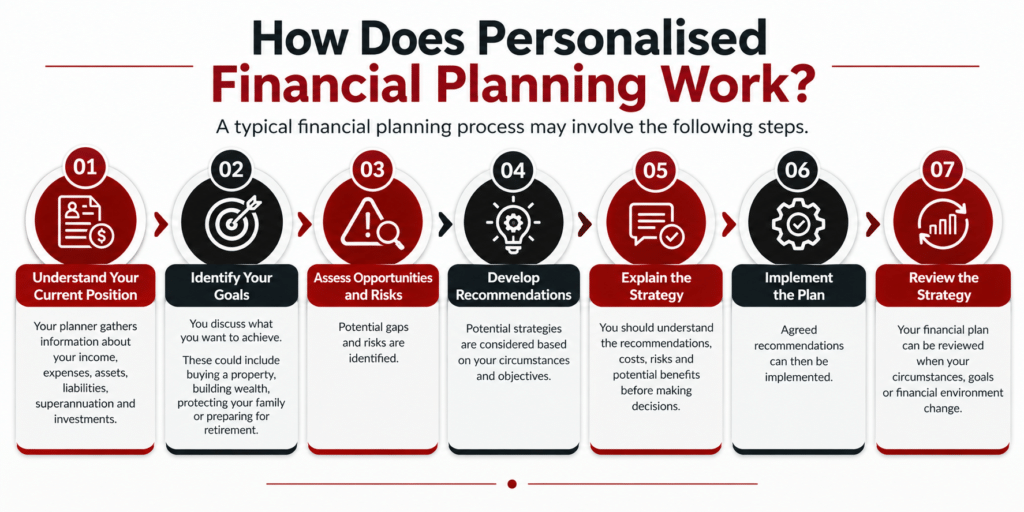
How Does Personalised in Mulgrave Do?
Why Choose Future Needs for Financial Planning?
If you are searching for a Trusted Financial Planner in Mulgrave, Future Needs can be considered as a financial planning option for individuals and families seeking support across different stages of their financial lives.
Future Needs’ financial planning approach can cover areas including:
Retirement planning
Investment advice
Superannuation advice
Wealth management
Insurance consultation
Debt management
Financial goal setting
A Long-Term Perspective
Financial planning should not be limited to a single financial decision.
A broader strategy can consider how today’s decisions may affect future goals.
Personalised Planning
Every household has different financial priorities.
Your financial plan should reflect your income, assets, liabilities, goals, timeframe and personal circumstances.
Ongoing Reviews
Financial circumstances can change because of career moves, property purchases, family changes, inheritance, business decisions or retirement.

FREQUENTLY ASKED QUESTIONS
A financial planner helps clients understand their financial position, establish goals and consider strategies involving investments, superannuation, retirement, insurance, cash flow and wealth management.
Compare qualifications, authorisations, services, fees, communication style and ongoing support. You can also check adviser information through ASIC’s Financial Advisers Register.
Not necessarily, but professional advice can be useful when you have complex financial decisions or want help establishing a long-term financial strategy.
Yes, an appropriately authorised financial adviser may provide advice about superannuation, including investment options, contributions and retirement planning.
Retirement planning can begin at any stage. Starting earlier may give you more time to understand your financial position and consider potential adjustments.
Fees vary depending on the adviser, the services provided and the complexity of your circumstances. Ask for a clear explanation of fees before proceeding.
An appropriately authorised financial adviser may provide investment advice based on your circumstances, objectives and risk considerations.
The terms are often used interchangeably in Australia. What matters is the specific services offered, qualifications, authorisations and scope of advice provided.
There is no universal schedule. A review may be appropriate when your income, family circumstances, assets, investments, goals or retirement plans change.
Yes. Families may use financial planning to consider investments, superannuation, insurance, debt, cash flow and long-term financial goals.